
Table of Contents
- Quick Answer
- Key Takeaways
- Two NEET 2027 Aspirants, Same Goal
- Where Their Preparation Starts to Differ
- The Problems Students Often Cannot See
- Why Self-Review Is Difficult
- What an Objective Preparation Review Looks Like
- How ReviewMyPrep Helps NEET 2027 Aspirants
- Which ReviewMyPrep Service Fits Your Problem?
- What Your Preparation Review Should Answer
- What Happens After a ReviewMyPrep Session?
- The Real Difference Between the Two Aspirants
Preparing for NEET 2027 is not only about completing chapters, solving questions, and increasing study hours. It is also about knowing whether the way you are preparing is actually working.
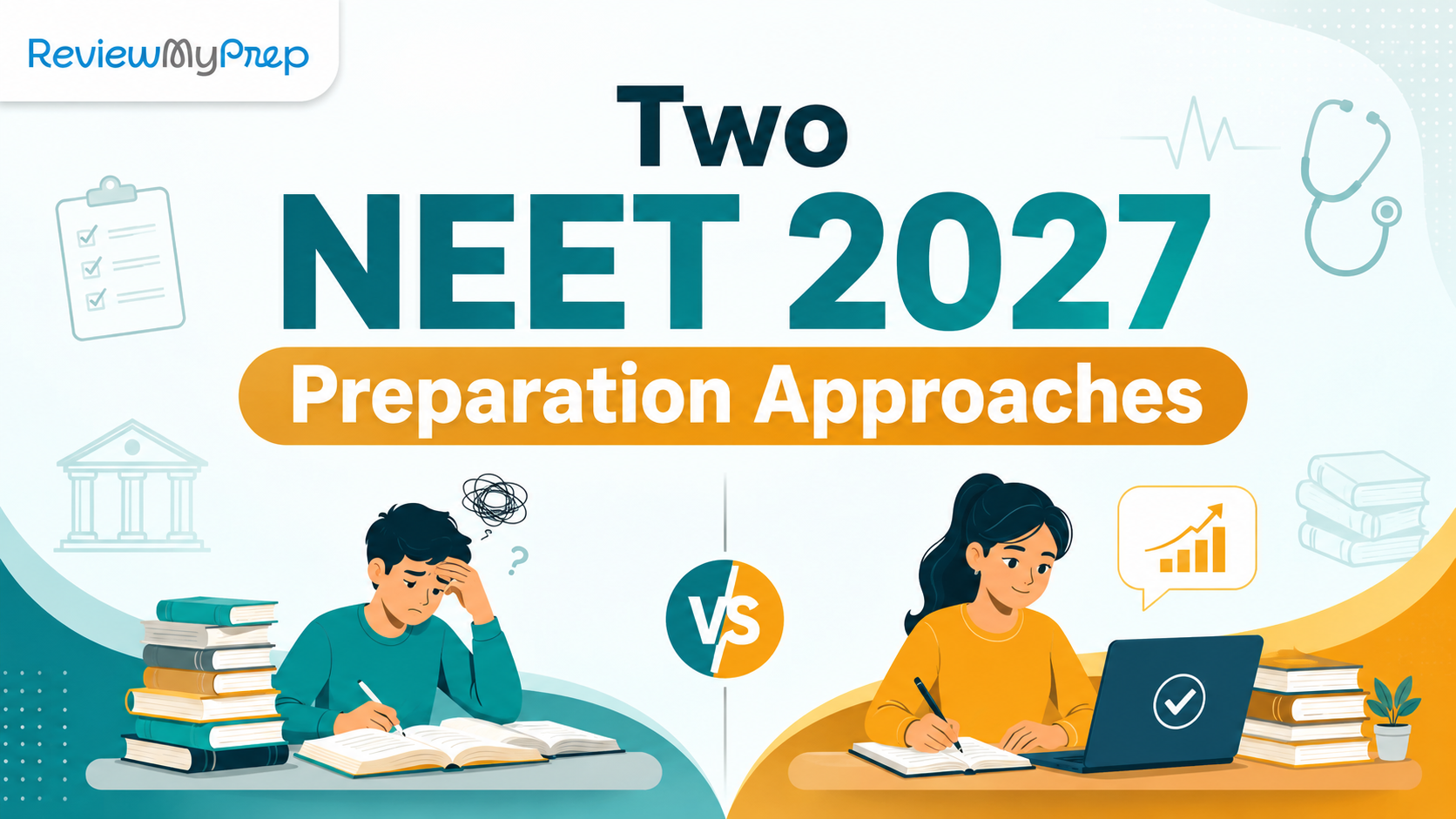
Imagine two students, Aditi and Rohan. Both are preparing for NEET 2027. Both attend classes, study every day, solve questions, and want a medical seat. On paper, their preparation looks almost identical.
But there is one major difference.
Aditi regularly reviews her preparation. She checks where her time is going, which chapters are weak, which resources are actually helping, and why her test performance is not improving.
Rohan keeps studying without stopping to evaluate the system behind his preparation.
This difference may look small in the beginning. Over months, however, it can change how efficiently both students use their preparation time.
That is where a structured preparation review can help. ReviewMyPrep is designed around this idea: instead of simply telling students to study harder, it helps them identify what needs to change.
Quick Answer
A good NEET 2027 preparation strategy is not just a timetable.
It should help you track your progress, identify weak areas, control your study resources, improve revision, and learn from test performance.
The difference between two aspirants may not be how many hours they study. It may be whether they regularly evaluate what is working and what is wasting their time.
ReviewMyPrep helps students do this through Productivity Check, Study Material Analysis, Subject Roadmap, and Direct One-on-One Sessions with experienced successful aspirants and mentors.
Key Takeaways
- More study hours do not automatically mean better preparation.
- Your preparation needs regular review, not just a timetable.
- Too many books, notes, and online resources can create unnecessary repetition.
- Mock tests are more useful when you analyse your mistakes after taking them.
- A weak subject needs a specific improvement plan, not just more general studying.
- ReviewMyPrep focuses on analysing preparation gaps rather than offering only generic motivation.
- A personalized post-session PDF report helps students turn feedback into specific next steps.
Table of Contents
- Two NEET 2027 Aspirants, Same Goal
- Where Their Preparation Starts to Differ
- The Problems Students Often Cannot See
- Why Self-Review Is Difficult
- What an Objective Preparation Review Looks Like
- How ReviewMyPrep Helps NEET 2027 Aspirants
- Which ReviewMyPrep Service Fits Your Problem?
- What Your Preparation Review Should Answer
- Common Mistakes Students Should Avoid
- What Students Should Do Next
- Related Guides on ReviewMyPrep
- FAQs
- Final Thoughts
Two NEET 2027 Aspirants, Same Goal
Let us look at two fictional students preparing for NEET 2027.
Meet Aditi
Aditi has a fairly regular routine.
She attends her classes, studies Biology from NCERT, solves Physics questions, practices Chemistry, and gives tests whenever they are scheduled.
She feels that she is working hard.
But every few weeks, she asks herself some uncomfortable questions:
- Am I spending enough time on my weakest subject?
- Why am I forgetting chapters I studied last month?
- Which mistakes keep appearing in my tests?
- Am I actually using all these books?
- Are my study hours productive?
- What should I change next month?
Instead of simply increasing her study hours, she tries to find the reason behind the problem.
Meet Rohan
Rohan is also working hard.
He attends the same type of classes, studies for several hours, solves questions, and buys additional books whenever he feels that his preparation needs a boost.
When his test score does not improve, he assumes he needs to study more.
So he adds another lecture.
Then another question bank.
Then another revision schedule.
His preparation becomes bigger, but not necessarily better.
This is a common problem among competitive exam aspirants.
The issue is not always lack of effort.
Sometimes, students simply cannot see the gap between what they are doing and what they actually need.
Where Their Preparation Starts to Differ
The biggest difference between Aditi and Rohan is not motivation.
It is evaluation.
Aditi treats preparation as something that needs to be checked and adjusted.
Rohan treats preparation as something that only needs more effort.
This distinction matters because NEET preparation has several moving parts.
You are managing:
- Classes
- Self-study
- Revision
- Question practice
- Mock tests
- Notes
- Books
- Coaching material
- Weak subjects
- Time management
- Previous-year questions
If one part of the system is inefficient, you can spend several hours every day without fixing the actual problem.
Example: Both Students Study Physics
Suppose both students are struggling with Physics.
Rohan decides to watch more lectures.
Aditi first checks why she is losing marks.
She may discover that she understands the concepts but makes calculation errors.
Or perhaps she understands the formula but cannot identify which formula to use.
Or maybe she has not practised enough questions after completing a chapter.
These are completely different problems.
And each one needs a different solution.
Simply studying more Physics does not tell you which problem you are actually trying to solve.
The Problems Students Often Cannot See
One of the hardest parts of NEET 2027 preparation is identifying problems while you are inside the preparation process.
You may feel that you are studying regularly.
But are those hours producing enough learning?
You may have five books for a subject.
But are you actually completing even two properly?
You may be taking mock tests.
But are you analysing your mistakes afterwards?
You may have a timetable.
But does it match your actual school, coaching, revision, and question-practice schedule?
These are preparation blind spots.
1. Studying for Long Hours Without Measuring Output
A student may spend eight hours at a desk but spend a significant part of that time watching lectures, switching resources, taking breaks, or rereading familiar material.
The number of hours looks impressive.
The actual output may not be.
Instead of asking only, "How many hours did I study today?", ask:
- What did I learn?
- What did I revise?
- How many questions did I solve?
- What mistakes did I correct?
- What should I remember tomorrow?
2. Using Too Many Resources
More resources can feel like better preparation.
In reality, multiple books covering the same chapters can create duplication.
A student may move between coaching notes, reference books, YouTube lectures, question banks, PDFs, and multiple test series without completing any one resource properly.
The goal should not be collecting resources.
The goal should be using the right resources effectively.
3. Not Knowing the Real Weak Areas
"I am weak in Physics" is not specific enough.
Which part of Physics?
Concepts?
Numericals?
Speed?
Accuracy?
A particular group of chapters?
Question selection?
Similarly, saying "Chemistry is weak" does not explain whether the problem is Physical, Organic, or Inorganic Chemistry.
A useful preparation review should turn a general problem into a specific one.
4. Taking Tests Without Analysing Them
A mock test gives you more than a score.
It can show patterns in your preparation.
For example:
| Test observation | Possible issue |
|---|---|
| Many incorrect answers from familiar topics | Concept recall or careless mistakes |
| Questions left despite knowing the topic | Time management |
| Same chapter repeatedly causes mistakes | Weak topic |
| High accuracy but low attempts | Speed or question selection |
| Scores remain similar for weeks | Preparation strategy may need review |
The exact solution depends on the student's situation.
That is why simply giving more tests is not always enough.
Why Self-Review Is Difficult
Students are often told to analyse their preparation themselves.
That sounds simple.
In practice, it can be difficult.
You are emotionally involved in your own preparation.
If you spent three weeks studying from a particular book, you may hesitate to accept that it is not helping.
If you studied for ten hours, you may feel that you must have had a productive day.
If you repeatedly struggle with one subject, you may start avoiding it instead of investigating why.
This is where an outside perspective can be useful.
A mentor who has already gone through a competitive exam preparation process can ask questions you may not think to ask yourself.
The purpose is not to tell every student to follow the same timetable.
It is to understand the student's current situation and suggest what can realistically be improved.
What an Objective Preparation Review Looks Like
An objective review should be based on the student's actual preparation, not generic advice.
For a NEET 2027 aspirant, that can include four areas.
Routine Review
Look at how the student actually spends a normal day.
This can include:
- School or coaching hours
- Self-study
- Revision
- Question practice
- Breaks
- Test preparation
- Sleep schedule
The purpose is not to create an unrealistic 14-hour timetable.
It is to identify where time is being lost and where the routine can become more practical.
Resource Review
List everything currently being used.
Then ask:
- Is this resource necessary?
- Does it duplicate another resource?
- Is the student actually completing it?
- Does it fit the student's current level?
- Is it helping with the specific weakness?
This can prevent preparation from becoming unnecessarily complicated.
Subject Review
Instead of saying "Biology is good" or "Physics is weak", look deeper.
Which chapters are strong?
Which chapters need revision?
Where are mistakes repeating?
Which topics need more questions?
What should be prioritised next?
Test Performance Review
A useful test review should look beyond the final score.
Students can examine:
- Incorrect answers
- Unattempted questions
- Time spent
- Repeated mistakes
- Weak chapters
- Conceptual gaps
- Careless errors
This turns a test from a simple scorecard into a learning tool.
How ReviewMyPrep Helps NEET 2027 Aspirants
ReviewMyPrep is a personalized mentorship and preparation analysis platform for JEE and NEET aspirants.
The focus is not simply on giving students a chance to talk to a topper.
The larger goal is to understand the student's preparation and identify practical areas for improvement.
Students can book sessions with verified toppers, IITians, NITians, medical students, and successful aspirants.
ReviewMyPrep offers four core services.
1. Productivity Check
This service focuses on how the student is actually using their time.
Students share details about their routine, study schedule, revision pattern, and time allocation.
The mentor can then identify possible productivity leaks and suggest a more practical approach.
For a student who constantly says, "I study all day but still cannot finish everything," this can help identify where the problem may be.
2. Study Material Analysis
If a student is using too many resources, the problem may not be a lack of material.
It may be resource overload.
In a Study Material Analysis session, students can share their books, coaching modules, notes, question banks, and online resources.
The mentor evaluates the preparation material and helps identify what should be continued and what can be removed.
The goal is a simpler preparation system where the student knows what to use and why.
3. Subject Roadmap
Sometimes the problem is limited to one subject.
A student may be comfortable with Biology but struggle with Physics.
Another student may have completed Organic Chemistry but still have gaps in Physical Chemistry.
The Subject Roadmap service focuses on the selected weak subject.
The mentor can help organise:
- Important topics
- Priority chapters
- Resource choices
- Revision strategy
- Question practice
- Scoring opportunities
The result should be a clearer path instead of another generic study timetable.
4. Direct One-on-One Session
Not every preparation problem fits neatly into one category.
Students may want to discuss:
- Mock test performance
- Preparation strategy
- Time management
- Motivation
- Exam pressure
- Subject difficulties
- Revision problems
- General preparation concerns
A Direct One-on-One Session gives students space to discuss the issue and get personalised guidance.
Which ReviewMyPrep Service Fits Your Problem?
| Your current problem | Service to consider |
|---|---|
| I study for long hours but cannot finish my plan | Productivity Check |
| I have too many books and resources | Study Material Analysis |
| I do not know how to improve one weak subject | Subject Roadmap |
| I have several preparation questions | Direct One-on-One Session |
| My mock scores are not improving | Productivity Check or Direct One-on-One Session |
| I keep changing my study strategy | Productivity Check |
| I do not know which resources to continue | Study Material Analysis |
| I need a clearer plan for a weak subject | Subject Roadmap |
The right service depends on the actual problem.
A student does not need to book every service simply because they are available.
The point of preparation analysis is to identify what is actually needed.
What Your Preparation Review Should Answer
By the end of a useful review, you should have clearer answers to questions such as:
What am I doing well?
Not every part of your preparation needs to change.
A good review should identify strengths worth continuing.
What is holding me back?
The answer should be specific.
"Study harder" is not an analysis.
"Your revision cycle is too irregular" or "you are using three resources for the same chapter without completing any" is much more actionable.
What should I stop doing?
Sometimes improvement comes from removing unnecessary activities.
That could mean reducing duplicate resources, unnecessary lectures, or inefficient study habits.
What should I prioritise?
Students often have dozens of pending tasks.
A useful plan should help separate urgent priorities from things that can wait.
What should I do next?
The review should end with action.
Knowing your weaknesses is useful.
Knowing what to do about them is better.
What Happens After a ReviewMyPrep Session?
One useful part of the ReviewMyPrep process is that the session does not have to end with a conversation.
After the session, students receive a detailed personalized PDF report, generally around 10 to 19 pages depending on the session and analysis.
The report can include:
- Current preparation analysis
- Strengths and weaknesses
- Subject-wise assessment
- Productivity evaluation
- Resource recommendations
- Books to continue
- Books to avoid
- Priority action items
- Personalized improvement plan
- Performance score out of 100
- Estimated preparation status
This gives students something they can return to after the session.
Instead of remembering a few points from a conversation, they have a structured reference for what to work on next.
The Real Difference Between the Two Aspirants
Go back to Aditi and Rohan.
Both are studying.
Both have books.
Both attend classes.
Both take tests.
The difference is that Aditi keeps asking whether her current system is working.
When she finds a problem, she adjusts.
Rohan keeps adding more effort to the same system.
This does not mean Aditi will automatically score higher or that Rohan cannot succeed.
NEET results depend on many factors, including learning, consistency, revision, question practice, test performance, and exam-day execution.
The point is simpler:
Working hard and reviewing how you work are two different things.
A preparation system becomes stronger when you regularly check whether it is producing the progress you want.
Common Mistakes Students Should Avoid
Mistake 1: Assuming More Hours Always Mean More Progress
Long study hours can be useful when they are productive.
But increasing hours should not be the automatic solution to every preparation problem.
First find the problem.
Mistake 2: Changing Resources Every Few Weeks
If every difficult chapter makes you search for a new teacher, book, or question bank, your preparation can become fragmented.
Give your chosen resources enough time to work.
Mistake 3: Ignoring Repeated Mistakes
If the same type of mistake appears in multiple tests, it deserves attention.
Do not simply calculate the score and move on.
Mistake 4: Making a Timetable Without Checking Reality
A timetable that looks perfect on paper may fail when combined with school, coaching, travel, homework, revision, and tests.
Your plan should fit your actual life.
Mistake 5: Comparing Your Preparation With Friends
Another student's study hours, coaching schedule, or resource list does not automatically make sense for you.
Compare your current performance with your own previous performance.
Mistake 6: Waiting Until the End to Review Preparation
Do not wait until the final months of NEET preparation to discover that your revision strategy is not working.
Regular checks can help you make changes earlier.
What Students Should Do Next
If you are preparing for NEET 2027, take a short pause and review your current preparation.
Ask yourself:
- What are my three strongest areas?
- What are my three biggest preparation gaps?
- Which subject needs the most attention?
- Which resources am I actually using?
- Which resources have I collected but barely touched?
- What are my most common mock-test mistakes?
- How often am I revising completed chapters?
- Is my daily routine realistic?
- What is the one change that could improve my preparation this month?
If you can answer these questions clearly, you already have a better understanding of your preparation.
If you cannot, that does not mean your preparation is bad.
It simply means there may be blind spots that need a closer look.
That is where a structured preparation review can help.
ReviewMyPrep allows NEET 2027 aspirants to get their preparation reviewed through focused services such as Productivity Check, Study Material Analysis, Subject Roadmap, and Direct One-on-One Sessions.
The goal is not to replace your existing preparation.
It is to understand it better and make it more efficient.
Related Guides on ReviewMyPrep
NEET 2027 Preparation Strategy: Study Plan for Class 11 & Class 12 Students
NEET 2027 Syllabus: Subject Wise Topics for Physics, Chemistry & Biology
Studying 10 Hours but Not Improving? NEET 2026 Productivity Audit Guide
NEET 2026 Marks vs Rank: Expected Score for Government Medical Colleges
NEET 2026 Cutoff: Expected Marks and Admission Chances
FAQs
Final Thoughts
NEET 2027 preparation is going to take months of consistent work.
During that time, it is easy to focus so much on completing the next chapter that you forget to ask whether your overall preparation is moving in the right direction.
That is the blind spot.
The difference between two aspirants is not always who studies more. Sometimes it is who notices the problem earlier and changes their approach.
A timetable tells you what to study.
A preparation review helps you understand whether the way you are studying is actually working.
That is the idea behind ReviewMyPrep.
Through Productivity Check, Study Material Analysis, Subject Roadmap, and Direct One-on-One Sessions, students can get a closer look at the parts of their NEET 2027 preparation that are difficult to evaluate alone.
So before adding another book, another lecture, or another few hours to your schedule, stop and ask one question:
Do you know what your preparation is missing?
If the answer is no, maybe the next step is not more studying.
Maybe it is a better review.